Now that 2011 nears an end, websites are steadily posting those top stories of the year. Here's what ABCNews.com says were Google's and Yahoo's "fastest rising searches" for 2011.
http://abcnews.go.com/Technology/google-top-searches-2011-rebecca-black-herman-cain/story?id=15156587

12.14.2011
Journalists on Twitter
Many editors and professors encourage (strongly) for their journalists to be active on Twitter. However, at the same time, criticize the under-reported and inaccurate information that is often posted on the social media site, not necessarily by journalists. My question is this, in order to further define the distinction between active citizenship and journalism, would journalists be better served just staying off of Twitter?
12.12.2011
So it's not really out with the old, then
This post on Chris Daly's blog reminded me of the brewing feud between the FONers and the FOMers that we discussed today in class. Daly is a journalism professor at Boston University.
12.11.2011
Twitter's New Design
Speaking of twitter, the New York Times recently released this article about some design changes the social network is making to attract more users and advertisers.
http://bits.blogs.nytimes.com/2011/12/08/twitter-tries-to-simplify-its-service/?scp=1&sq=twitter%20tries%20to%20simplify&st=cse
http://bits.blogs.nytimes.com/2011/12/08/twitter-tries-to-simplify-its-service/?scp=1&sq=twitter%20tries%20to%20simplify&st=cse
12.09.2011
ESPN Twitter policy
Back in September the Houston Texans starting running back, Arian Foster, tweeted a photo of his injured hamstring. This was not a violaiton of the NFL's twitter policy and therefore no League action was taken. However, the ability of athletes to break their own news poses serious conseuences for the future of journalism. Some fear that one day players, leagues, teams, or colleges will no longer need a middleman to cover them. Will athletes' ability to release their own information seriously cripple journalists' ability to make a living? Does Foster's twitpic of his hamstring portend a bleak future for journalism?
12.08.2011
An example of breaking news on an online-only news magazine
News is breaking today about a gunman who killed two people at Virginia Tech's campus.
As an example of how a modern news website combines breaking news, here's Huffington Post's page of coverage on the event.
It has a text story that's been edited throughout the day, links to multiple videos, a live blog, a link to another news source's live news feed, and a Twitter feed.
In such a short time, all this has been added to the story in a practice which is now considered to be standard. Journalism has never been so multimedia-focused.
As an example of how a modern news website combines breaking news, here's Huffington Post's page of coverage on the event.
It has a text story that's been edited throughout the day, links to multiple videos, a live blog, a link to another news source's live news feed, and a Twitter feed.
In such a short time, all this has been added to the story in a practice which is now considered to be standard. Journalism has never been so multimedia-focused.
This afternoon, Dec. 8
This just landed in my inbox:
I wanted to let you know that this afternoon, December 8, the Center for Technology Innovation at Brookings will be webcasting a forum exploring how mobile technology can ease the everyday lives of Americans. I will moderate a discussion with Chris Dede of Harvard University and my Brookings colleague Allan Friedman. Peggy Johnson, executive vice president and president of Global Market Development at Qualcomm, will provide opening remarks.
You can view the webcast LIVE at:
http://www.brookings.edu/events/2011/1208_mobile_technology.aspx
The webcast will run from 2:00 - 3:30pm EST today.
You can follow the conversation on Twitter using the hashtag #CTIMobile.
I also have published a new paper, "Ten Facts about Mobile Broadband," showing how the mobile economy, which generates $1.3 trillion in annual revenues, is reshaping the global landscape. There are major opportunities to create jobs, and create social and economic connections in both developed and emerging markets.
Thanks again for your support and I hope you enjoy the webcast. The archived video and related material will be available at this link in the days and weeks ahead.
Darrell West
Vice President and Director, Governance Studies
I wanted to let you know that this afternoon, December 8, the Center for Technology Innovation at Brookings will be webcasting a forum exploring how mobile technology can ease the everyday lives of Americans. I will moderate a discussion with Chris Dede of Harvard University and my Brookings colleague Allan Friedman. Peggy Johnson, executive vice president and president of Global Market Development at Qualcomm, will provide opening remarks.
You can view the webcast LIVE at:
http://www.brookings.edu/
The webcast will run from 2:00 - 3:30pm EST today.
You can follow the conversation on Twitter using the hashtag #CTIMobile.
I also have published a new paper, "Ten Facts about Mobile Broadband," showing how the mobile economy, which generates $1.3 trillion in annual revenues, is reshaping the global landscape. There are major opportunities to create jobs, and create social and economic connections in both developed and emerging markets.
Thanks again for your support and I hope you enjoy the webcast. The archived video and related material will be available at this link in the days and weeks ahead.
Darrell West
Vice President and Director, Governance Studies
Most Kids Want an IPAD for Christmas
I saw this story on WUSA-TV this morning and thought about you, Chris! According to Nielson.com, the iPad tops Santa's wish list, followed by the iPod Touch.
http://blog.nielsen.com/nielsenwire/consumer/us-kids-looking-forward-to-iholiday-2011/
http://blog.nielsen.com/nielsenwire/consumer/us-kids-looking-forward-to-iholiday-2011/
12.07.2011
What the Frack Is Going On?
How would you explain a complicated environmental issue like fracking?
Check out how students at NYU did it, with this video, selected by Time Magazine as one of the most creative of the year.
Check out how students at NYU did it, with this video, selected by Time Magazine as one of the most creative of the year.
12.06.2011
Maybe USA Today isn't the Evil Empire!

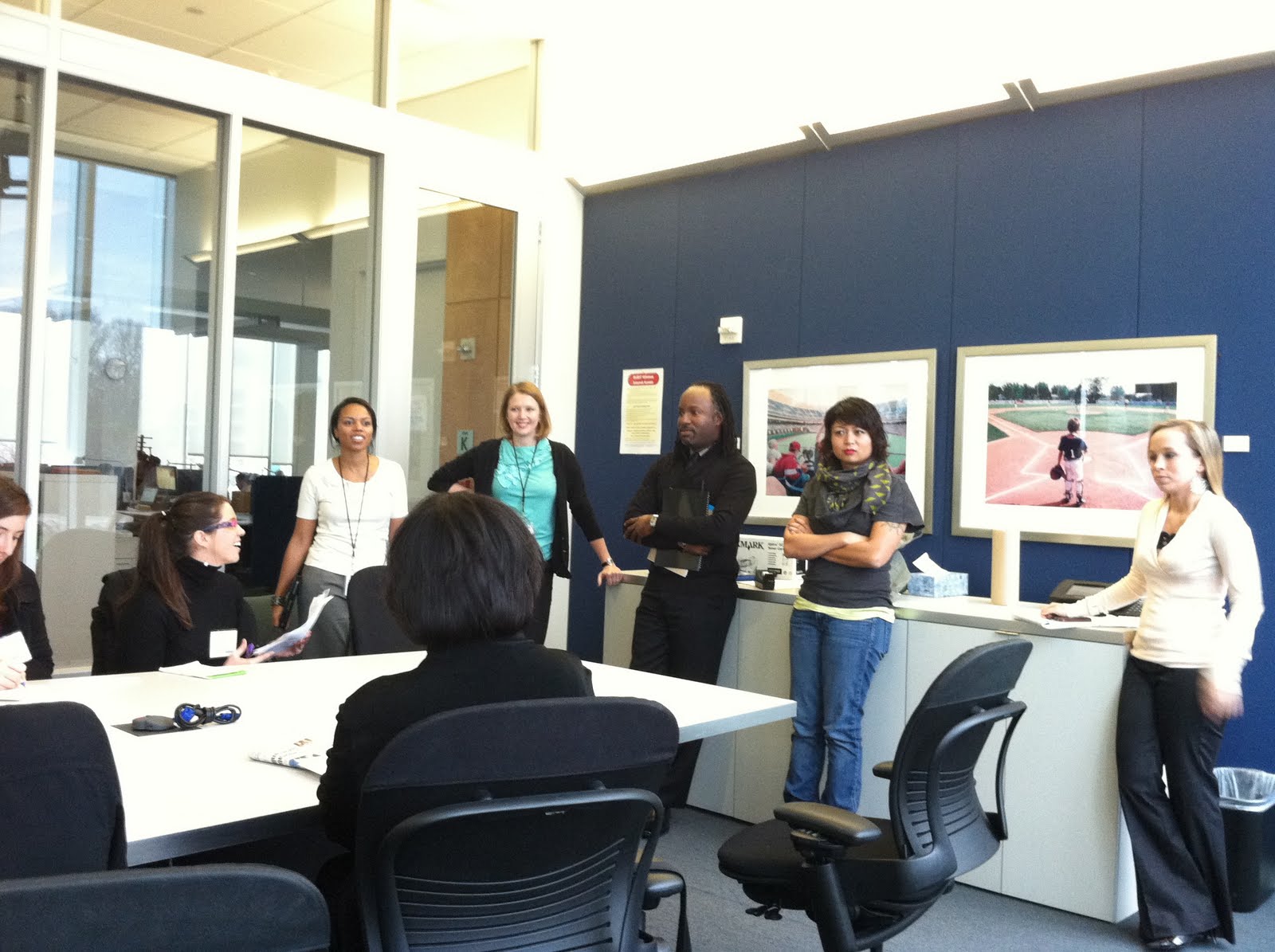

OK, I admit it. I had a bias going in on this trip. Having done work in the 90's for Channel 9, also owned by Gannett, I had heard lots of bad stuff about the newspaper side of the company. How it sucked up money from everything else. When I saw the new building I could believe it. But I came away from this visit really impressed.
It seems to me that USA Today in terms of the digital space is doing a ton of things right. Frankly, they are doing stuff I wish we at NPR were doing. The fact they now have the print and digital folks together is not unique. Everyone is trying the same thing, but it appears they have done a better job of making it work. I also like the fact they appear to have a true employee mentoring and development program. Believe me not everyone does these days!
So, anyway..I liked what I saw. I also like that upper level folks are giving journalists and others the chance to play with the new technology. Here are a few shots from our trip, since you probably noticed I was taking lots of iPhone pictures.
12.04.2011
Google Maps
I ran across this interesting article about new innovations in Google Maps. Basically, Google is making this new feature just for Android phones right now, but people will be able to use Google Maps to get directions for inside locations like shopping malls and airports. They just introduced this news this week, so it could be adapted for the future.
I think this is interesting in that it just shows how vital features like using Google Maps to get directions are in this day and age. By making it only available on Android, it also promotes how important smart phones are as tools for things not just for entertainment and communication.
You don't usually think to get directions to inside locations, but a map of a place like a airport could be really useful if you're in an unfamiliar city.
I think this is interesting in that it just shows how vital features like using Google Maps to get directions are in this day and age. By making it only available on Android, it also promotes how important smart phones are as tools for things not just for entertainment and communication.
You don't usually think to get directions to inside locations, but a map of a place like a airport could be really useful if you're in an unfamiliar city.
12.03.2011
Cool Graphic Online
Check out this cool graphic on The Economist magazine website.
It compares American states to other countries with similar populations and similarly sized economies (measured by GDP).
Vermont has the nation's smallest economy. It is the size of Yemen.
California's is the size of Italy. If it were a country it would be one the world's ten largest economies!
Everyone knows that the United States has a large economy (by far the word's largest), but it's weird to think of the fact that it is larger than the aggregate economy of 50 different countries.
Besides helping the reader conceptualize economy and populations sizes in new ways, the graph is very interactive.
You can click on the individual states for more details.
There is also a similar graph for Chinese, Indian and Brazilian states or provinces. I like the layout of the international graphics better because the graphs are on the side of, rather than below, the map.
Enjoy!
11.30.2011
USA Today Trip on Monday
Class, a reminder: We'll be meeting with editors at USA Today at 10:55 a.m. next Monday, in lieu of class. We'll likely stay till 12:30, for a tour and chat with social media editors and others. You'll need to car pool. I can comfortably fit three additional bodies into my car, and will be coming and going from campus. (Four would be a squish, but I'll do it if necessary.) Since I need to beat the rest of you there, I'll likely leave the building no later than 9:30 a.m. Let me know if you'd like to ride with me. For the rest of you, I'll start a thread on our blog so you can arrange carpools. Normally, it takes about an hour and 15 minutes in rush hour to get there, and about 45 minutes in non-rush hour to return. The address is:
7950 Jones Branch Drive
McLean, Va. 22108
The main switchboard is phone: 703-854-3400.
I put driving directions, from google, on our Blackboard site.
Note: Just before you get to the building, you'll see a guard's shack on your right. You need to pull up to it, and tell the guard (or the intercom button) your name. I'm emailing over all your names today. Tell them you're with the group from UMD, and you're meeting with staffers Desair Brown Shaw and Mary Hartney. You'll be directed to a parking lot and/or garage adjacent to the building. We'll meet in the lobby no later than 10:55 a.m. I will give you a sheet of questions to answer afterward, as a class assignment. Please take a deep look at the site before Monday, so you can ask good questions.
If you need to carpool, please put a note into comments below to make arrangements with classmates.
7950 Jones Branch Drive
McLean, Va. 22108
The main switchboard is phone: 703-854-3400.
I put driving directions, from google, on our Blackboard site.
Note: Just before you get to the building, you'll see a guard's shack on your right. You need to pull up to it, and tell the guard (or the intercom button) your name. I'm emailing over all your names today. Tell them you're with the group from UMD, and you're meeting with staffers Desair Brown Shaw and Mary Hartney. You'll be directed to a parking lot and/or garage adjacent to the building. We'll meet in the lobby no later than 10:55 a.m. I will give you a sheet of questions to answer afterward, as a class assignment. Please take a deep look at the site before Monday, so you can ask good questions.
If you need to carpool, please put a note into comments below to make arrangements with classmates.
11.27.2011
Commission in EU Turns Spotlight on Facebook over Privacy Concerns
A battle is brewing in the European Union over privacy concerns with Facebook.
The Telegraph reports on the European Commission's concerns over the social media giant's use of users' personal info by advertisers.
Have you personally found the targeted ads on Facebook off-putting?
The Telegraph reports on the European Commission's concerns over the social media giant's use of users' personal info by advertisers.
Have you personally found the targeted ads on Facebook off-putting?
11.21.2011
Headlines
Both of these headlines are from the Washington Post
Good Headline: ‘Al-Qaida sympathizer’ accused of NYC bomb plots; defense says he’s no conspirator
Very descriptive headline that gets straight to the point. I almost feel like I don't need to read the rest of the article with headlines like these.
Bad Headline: Peyton Manning to start at QB for Redskins in 2012
Note: This article has been altered since I found it a few days ago.
Blatant example of a misleading headline. The opinion article headline was followed by the phrase: "How's that for a headline? Got your attention, didn't it?" and explained that this was only a hypothetical situation and there are about eight different factors that need to fall in place in order for this to happen.
Good Headline: ‘Al-Qaida sympathizer’ accused of NYC bomb plots; defense says he’s no conspirator
Very descriptive headline that gets straight to the point. I almost feel like I don't need to read the rest of the article with headlines like these.
Bad Headline: Peyton Manning to start at QB for Redskins in 2012
Note: This article has been altered since I found it a few days ago.
Blatant example of a misleading headline. The opinion article headline was followed by the phrase: "How's that for a headline? Got your attention, didn't it?" and explained that this was only a hypothetical situation and there are about eight different factors that need to fall in place in order for this to happen.
Drew Grossman: Headlines
Time.com
http://www.time.com/time/magazine/article/0,9171,2099675,00.html
This is a cute headline but it doesn't really tell the reader what the story is about. If you have been keeping up with the story then you will get it, but this will go over the head of the average reader.
Winners and Losers of the Deficit Supercommittee Deadlock
http://swampland.time.com/2011/11/21/with-the-supercommittee-poised-for-failure-winners-and-losers-in-washington/
This is a good headline because it tells the readers exactly what the story will be about. The headline is clear and easy to understand.
11.20.2011
CNN Layoffs
CNN recently announced it would lay off about 50 workers, stating an "evolution allows more people in more places to edit and publish than ever before."
Just goes to show, how important it is to keep those multi-media skills up to date. Read more on Mediaite.com:
http://www.mediaite.com/tv/report-cnn-lays-off-at-least-50-editors-photographers-and-other-staffers/
Just goes to show, how important it is to keep those multi-media skills up to date. Read more on Mediaite.com:
http://www.mediaite.com/tv/report-cnn-lays-off-at-least-50-editors-photographers-and-other-staffers/
11.19.2011
The Evolution of the News Cycle
What does the breaking news cycle look like today on the multiple platforms where it's published? And how might it look in the future--if we move onto an all-digital platform?
A smart analysis from Lauren Rabaino of the confusing, and often dead-end, threads that now greet readers trying to follow a story as it develops: http://www.mediabistro.com/10000words/the-new-convoluted-life-cycle-of-a-newspaper-story_b8552.
How could the publishing platform(s) be improved?
A smart analysis from Lauren Rabaino of the confusing, and often dead-end, threads that now greet readers trying to follow a story as it develops: http://www.mediabistro.com/10000words/the-new-convoluted-life-cycle-of-a-newspaper-story_b8552.
How could the publishing platform(s) be improved?
11.18.2011
Strong and Not-so-Strong Headlines
Class, a reminder to please post a comment to this thread before the next class on good and bad headlines. Here are the instructions from your class schedule:
Please find a good and not-so-adept headline on one or more news Web sites, and explain why you think so. Please be sure to give the full URL and headline for each. Include a sentence or two of constructive comments. Please be sure your criticism is tactful: Our class blog is online for the world to see (although only the class can comment to it.) Please don't write anything you'd be embarrassed by if strangers see.
To refresh your memory on what makes a good and bad headline, please read the headline area of this Web writing handout: http://www.newsline.umd.edu/italy/writing.htm
And please review the headline sections of this handout: http://multimedia.journalism.berkeley.edu/tutorials/seo-search-engine-optimization-basics/seo-newsroom/
Please find a good and not-so-adept headline on one or more news Web sites, and explain why you think so. Please be sure to give the full URL and headline for each. Include a sentence or two of constructive comments. Please be sure your criticism is tactful: Our class blog is online for the world to see (although only the class can comment to it.) Please don't write anything you'd be embarrassed by if strangers see.
To refresh your memory on what makes a good and bad headline, please read the headline area of this Web writing handout: http://www.newsline.umd.edu/italy/writing.htm
And please review the headline sections of this handout: http://multimedia.journalism.berkeley.edu/tutorials/seo-search-engine-optimization-basics/seo-newsroom/
11.13.2011
A Must-Read on Aggregation
Jack Shafer writes a thoughtful piece about best practices for aggregation, while offering a defense for Jim Romenesko, who stepped down after a dozen years from his post at Poynter.
11.11.2011
On becoming a student entrepreneur
Amy Reinink, who is an SPJ-DC member and friend, just wrote a great piece for the Washington Post Magazine on college students who are either skipping college to become entrepreneurs or graduating from school as their own boss. While the University of Maryland probably does not want us to skip out on our graduate studies, there are some valuable lessons from this story that I think our professors would urge us to use and apply. I think that to a large extent, digital and online media give us an opportunity as journalists to think in new and exciting ways.
Read the article:
http://www.washingtonpost.com/lifestyle/magazine/student-entrepreneurship-in-college-is-on-the-rise-in-poor-economy/2011/10
Listen to the NPR interview:
http://www.npr.org/player/v2/mediaPlayer.html?action=1&t=1&islist=false&id=142211120&m=142211111
Read the article:
http://www.washingtonpost.com/lifestyle/magazine/student-entrepreneurship-in-college-is-on-the-rise-in-poor-economy/2011/10
Listen to the NPR interview:
http://www.npr.org/player/v2/mediaPlayer.html?action=1&t=1&islist=false&id=142211120&m=142211111
11.09.2011
Join us to discuss media diversity in Brazil, South Africa, US with 3 guest speakers
 I thought you might be interested in a seminar a colleague and I are moderating this Friday at 1.30pm. Paulo Rogerio is from Brazil, and he will be talking about media diversity in Brazil and I will be giving the perspective from South Africa. There will also be three guest speakers from leading agencies in the U.S.
11.04.2011
" Why Johnny Can't Search"
This the title of an article in this months edition of " Wired." I think it sums up quite succinctly the reason why we as journalists need to be highly suspect of Internet search results. As the article by clive@clivethompson.net points out, " kids know how to Google- they just can't tell when the results are crap." (pg.062)
In his piece Thompson cites a study done by College of Charleston business professor Bing Pan. Pan and his team gathered a group of students and asked them to search. Not surprisingly students often relied on top results on a Google page. He then switched around the order of the results and students still used the top rated results. And in almost every case the students, most of whom are " digital natives", failed to do the most basic things, like checking an authors credentials or examining where the item came from.
The bottom line of the piece is students aren't being given the most basic instruction on how to separate the " wheat from the chaff" on the Internet.The article suggests by the time students are in college most professors expect them to know this, but why? Its not as though this is a skill that's taught in most schools. And the article goes on to say it's not just the URL but also the tone of the piece that should be looked at.
Not unlike what we were asked to do on our recent mid-term. In the world of online reporting perhaps " crap detection" is one of the most important skills we can have.
The author notes that's especially true at a time that the lines between news and infotainment are becoming quite blurred.
In his piece Thompson cites a study done by College of Charleston business professor Bing Pan. Pan and his team gathered a group of students and asked them to search. Not surprisingly students often relied on top results on a Google page. He then switched around the order of the results and students still used the top rated results. And in almost every case the students, most of whom are " digital natives", failed to do the most basic things, like checking an authors credentials or examining where the item came from.
The bottom line of the piece is students aren't being given the most basic instruction on how to separate the " wheat from the chaff" on the Internet.The article suggests by the time students are in college most professors expect them to know this, but why? Its not as though this is a skill that's taught in most schools. And the article goes on to say it's not just the URL but also the tone of the piece that should be looked at.
Not unlike what we were asked to do on our recent mid-term. In the world of online reporting perhaps " crap detection" is one of the most important skills we can have.
The author notes that's especially true at a time that the lines between news and infotainment are becoming quite blurred.
11.03.2011

11.01.2011
Twitter, Facebook to star in 2012 election
 I was referred to this survey, conducted by Digitas and Harris Interactive, by this story. There I was, reading through it, when I hit paragraph two, which said that :
"A recent survey of adults found that a majority of respondents — 61 percent – said they expect candidates in the 2012 U.S. presidential election to have a social media presence. And 38 percent of respondents in the survey, which polled adults on behalf of brand agency Digitas, said that information found on social media sites such as Twitter and Facebook will help determine their voting choices just as much as TV or newspapers."
Well, no. That's not what the survey says. Look in the box on the top left of the graphic. It says that six out of 10 social media users think presidential candidates should increase their presence on things like Twitter and Facebook. The box next to it says that 82 percent of American grown-ups use social media. If you do the math, we end up with 50 percent of the population saying they want presidential hopefuls to up their presence on social media. That's still a sizeable percentage and number, but it's also wrong to say that six in 10 Americans think a presence on Twitter and Facebook are key to how they'll vote next year.
Who does it surprise to learn that social media users think the next president should use social media? Not me. I mean, look at the role that Twitter and Facebook played in the Arab Spring uprisings, that social media is playing in Syria, and that it played in President Obama's successful election campaign in 2008.
The real news in this survey was spotted by Matt Carmichael, who wrote about it on the AdAgeStat blog.
"Perhaps the surprising thing... is the stat that 40% of social-media users don't expect candidates to have a social-media presence."
Carmichael goes on to say that the politician who does not use social media is as backwards as -- and he lets us fill in the blanks. Maybe he's too young to remember the rotary phone and the time when party lines had nothing to do with how politicos voted but referred to someone you shared a phone line with, but that would be a good one to fill in the blanks with.
In any case, I found the original story to be a good example of why you should always go back to the original source of a story to double-check facts. In this case, that meant going back to the survey.
I am not saying that Twitter and Facebook are not key tools that candidates for the White House have to master. They are. As Digitas senior vice president Jordan Bitterman, who is also the agency's social marketing practice director (that has to be in the running for job title of the year), said in a release posted on PR Newswire:
"JFK is considered the first television President. Next year's victor may well be determined by the impact of Facebook and Twitter."
10.30.2011
Will there be a future for social media editors?
I attended the Journalism Interactive conference on Friday, and I really enjoyed the Friday morning session on journalism and social media use. New York Times social media editor, Liz Heron was on the panel and said that she thought her job might not be around in five years. You can see more of what she said here: http://www.niemanlab.org/2011/10/heron-i-think-my-job-will-probably-not-exist-in-five-years/ (source: Nieman Lab).
I thought it was a pretty bold statement, given that many journalists still do not use social media or are hesitant to sign-up. What do you think? Given that there is a heightened focus on social media, will jobs like Heron's still be around in five years? Or do you think there will always be a need for a social media editors within the newsroom?
I thought it was a pretty bold statement, given that many journalists still do not use social media or are hesitant to sign-up. What do you think? Given that there is a heightened focus on social media, will jobs like Heron's still be around in five years? Or do you think there will always be a need for a social media editors within the newsroom?
10.29.2011
Introducing Visual.ly
Hello Everyone,
I came across Visual.ly - a new infographics start-up - a few weeks ago and since I wanted to share it with you. This video tells who they are and what they do very effectively. It's just another source that shows the power of infographics and data visualizations today.
This one was one of my favorites.
I came across Visual.ly - a new infographics start-up - a few weeks ago and since I wanted to share it with you. This video tells who they are and what they do very effectively. It's just another source that shows the power of infographics and data visualizations today.
This one was one of my favorites.


10.25.2011

10.24.2011
It's Never Too Late
It is my belief that learning is life-long. Just consider how quickly technology changes from year to year. For this reason, and many others, more and more "older" students are returning to the classroom. Take a look at this clip.
58-Year-Old Proves It's Never Too late, by Post University
58-Year-Old Proves It's Never Too late, by Post University
Subscribe to:
Posts (Atom)


 Posts
Posts

